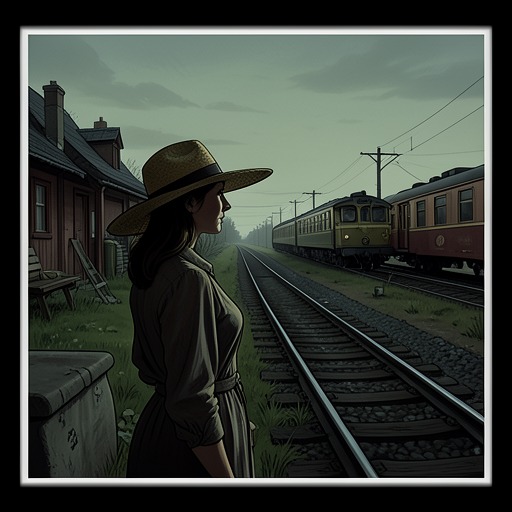
Fairy-Tale Form and Historical Truth
The Most Precious of CargoesFairy-Tale Form and Historical Truth is the book’s governing tension: a fairy tale declares its central story invented, yet insists that an act of love within it deserves to be true. The form neither disguises historical suffering as fantasy nor presents the invented plot as a record. Instead, the tale’s visible artifice and its documentary appendix ask the reader to hold invention and historical fact together without confusing them.
The Fable Announces Its Own Artifice
The story begins with the familiar fairy-tale formula of a poor woodcutter and his wife living in a great forest. The narrator immediately interrupts that convention, rejecting the resemblance to Hop o’ My Thumb and challenging the premise that parents would abandon children simply because they could not feed them. This interruption makes the fairy-tale voice self-conscious: it invokes a recognizable form, then refuses to let that form’s inherited expectations pass unquestioned. The frame is not a promise of an uncomplicated, consoling tale; it is a device the narrator can expose and revise.
The forest itself is described through another familiar fairy-tale feature: a secluded grove, dense and difficult to enter, set apart from ordinary paths and protected by its vegetation. The place is associated with beliefs in faeries, sprites, witches, and werewolves, and with a solitary human figure feared by those who live nearby. Such details establish the grammar of enchantment, but they also give the imagined world a specific structure of exclusion, rumor, and danger. The fairy-tale landscape does not remove historical reality from view; it provides the tale’s invented setting while the reader remains aware that the book’s subject reaches beyond it.
Denial and the Claim of a Deeper Truth
In the epilogue, the narrator directly addresses the reader and denies the story’s factual existence. The denial is sweeping: the cargo trains, camps, destroyed families, and other events and objects of the tale are declared not to have happened. Repeating that negation prevents the reader from mistaking the fable for documentary testimony. It also turns the question of truth into part of the narrative itself: the book does not quietly let its invented events stand in for actual history.
The narrator then makes a carefully qualified exception. The one thing said to be true, or to deserve truth within the story, is that a little girl was thrown from a cargo train in an act of love and despair, wrapped in a fringed Prayer shawl embroidered with gold and silver thread. A childless Poor Woodcutter’s Wife gathered her up, fed her, treasured her, and loved her more than life itself. The epilogue continues to identify the girl and the adoptive mother as nonexistent; its claim is therefore not that this episode is verified history. Rather, the form distinguishes factual existence from a truth of human feeling and ethical significance. The invented rescue cannot cancel the historical losses against which the book places it, but its insistence on care gives the fable a truth claim of its own.
Documentary Records Beside Invention
The appendix changes the register from fairy-tale narration to dates, counts, names, and archival reference. It records that Convoy 45 left the Drancy internment camp on November 11, 1942, with 778 men, women, and children, including elderly and infirm people and a blind man, Naphtali Grumberg, identified as the author’s grandfather. It adds the stark outcome that two people survived in 1945. These particulars do not authenticate the fable’s plot; they establish a historical record that the fiction’s repeated denials cannot make disappear.
The account of Convoy 49 supplies another family connection. It left on March 2, 1943, carrying 1,000 Jews, among them Zacharie Grumberg, identified as the author’s father, and Sylvia Menkès. Menkès was born on March 4, 1942, and died on March 4, 1943, the anniversary of her birth. The compressed dates place a single life within the measured chronology of deportation and death. Their precision contrasts with the tale’s deliberately impossible cargo and rescue, while making clear that the historical materials belong to actual people, not to the invented forest narrative.
The appendix also describes the Memorial to the Deportation of Jews from France, assembled in 1978 by Serge Klarsfeld from alphabetical lists of deported Jews. For many children of deportees, the book serves as a family vault. Its entry for Abraham and Chaja Wiesenfeld records their twin daughters, Fernande and Jeannine, born in Paris on November 9, 1943, and deported from the Drancy internment camp on December 7, only twenty-eight days later, on Convoy 64. The record’s names, family relations, birth date, and interval before deportation give documentary form to losses that the fairy tale cannot claim as its own.
How the Two Registers Work Together
The fable and the appendix perform different tasks. The story creates characters and events through fairy-tale convention; the appended records identify historical people, dates, and transports. The epilogue explicitly marks the boundary between those modes, first denying the invented narrative as fact and then specifying the emotional truth it wishes to preserve. The reader is asked neither to mistake fiction for evidence nor to treat fiction as meaningless because it is invented.
The resulting tension makes the book’s form part of its argument. Repetition, direct address, and categorical denial interrupt immersion and expose the act of telling; the documentary lists, by contrast, insist on particularity. The fable’s central act of adoption is not presented as a substitute for the histories named in the appendix. It offers an imagined instance of care alongside records of real families and real separations, keeping compassion and historical precision in view at once. Fairy-Tale Form and Historical Truth therefore rests not on collapsing invention into fact, but on making their difference unmistakable while asking what an invented story can still affirm.